Data leaves your boundary
Messages, files, and metadata sit on vendor infrastructure you do not operate. Jurisdiction, subpoena response, and breach notification timelines are negotiated, not owned.
On-premise · Self-hosted · Enterprise-grade
IM Enterprise is a complete messaging, files, and intelligence platform you deploy on infrastructure you control — with optional AI that respects permissions and never phones home.
Built for organizations that cannot outsource trust
The hidden cost of cloud chat
Most enterprise chat platforms were designed for convenience first and custody second. That trade-off compounds — in cost, compliance risk, and strategic dependency.
Messages, files, and metadata sit on vendor infrastructure you do not operate. Jurisdiction, subpoena response, and breach notification timelines are negotiated, not owned.
Per-user licensing punishes growth. Add contractors, partners, or whole departments and your bill climbs — while your negotiating leverage shrinks with every integrated workflow.
Cloud assistants ingest channel history to improve models you do not control. For regulated teams, that is not innovation — it is an undeclared data processor.
Certification badges on a marketing page do not equal operational control. Auditors ask where data lives, who can access it, and how retention is enforced — not which logo appears on a trust center.
Integrations, custom apps, and years of searchable history create soft lock-in. You are not renting software — you are renting continuity, at the vendor's renewal calendar.
Global SaaS routing adds hops. For air-gapped, sovereign, or high-latency environments, a cloud-first architecture is a structural mismatch — not a configuration issue.
A different contract
IM Enterprise replaces the SaaS dependency loop with software you deploy, operate, and govern — on hardware you already trust.
| Typical cloud chat | IM Enterprise | |
|---|---|---|
| Data residency | Vendor-controlled regions | Your data center or VPC |
| Pricing model | Per-seat, annual uplift | License + infra you control |
| AI processing | Shared cloud models | On-prem LLM (Ollama, vLLM, or internal API) |
| Tenant isolation | Application-layer only | PostgreSQL RLS + centralized RBAC |
| Branding | Logo swap at best | Full whitelabel — domains, colors, mobile shell |
| Audit & retention | Export APIs, vendor timelines | Append-only audit log, org-defined retention |
| Air-gapped deploy | Not supported | Docker Compose — fully offline capable |
One platform, complete stack
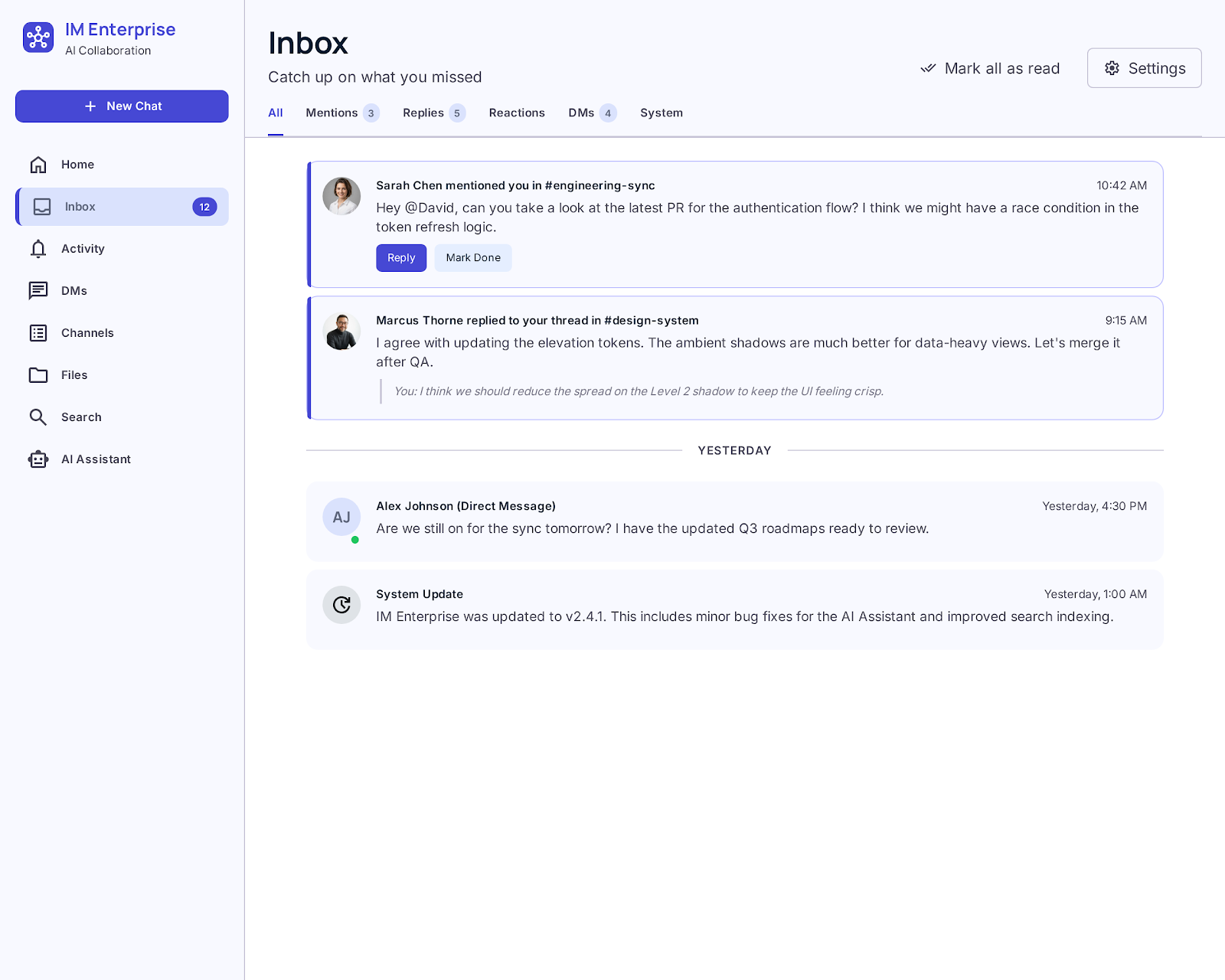
Channels, direct messages, threads, reactions, mentions, and presence — delivered through a dedicated WebSocket gateway, not bolted-on polling.
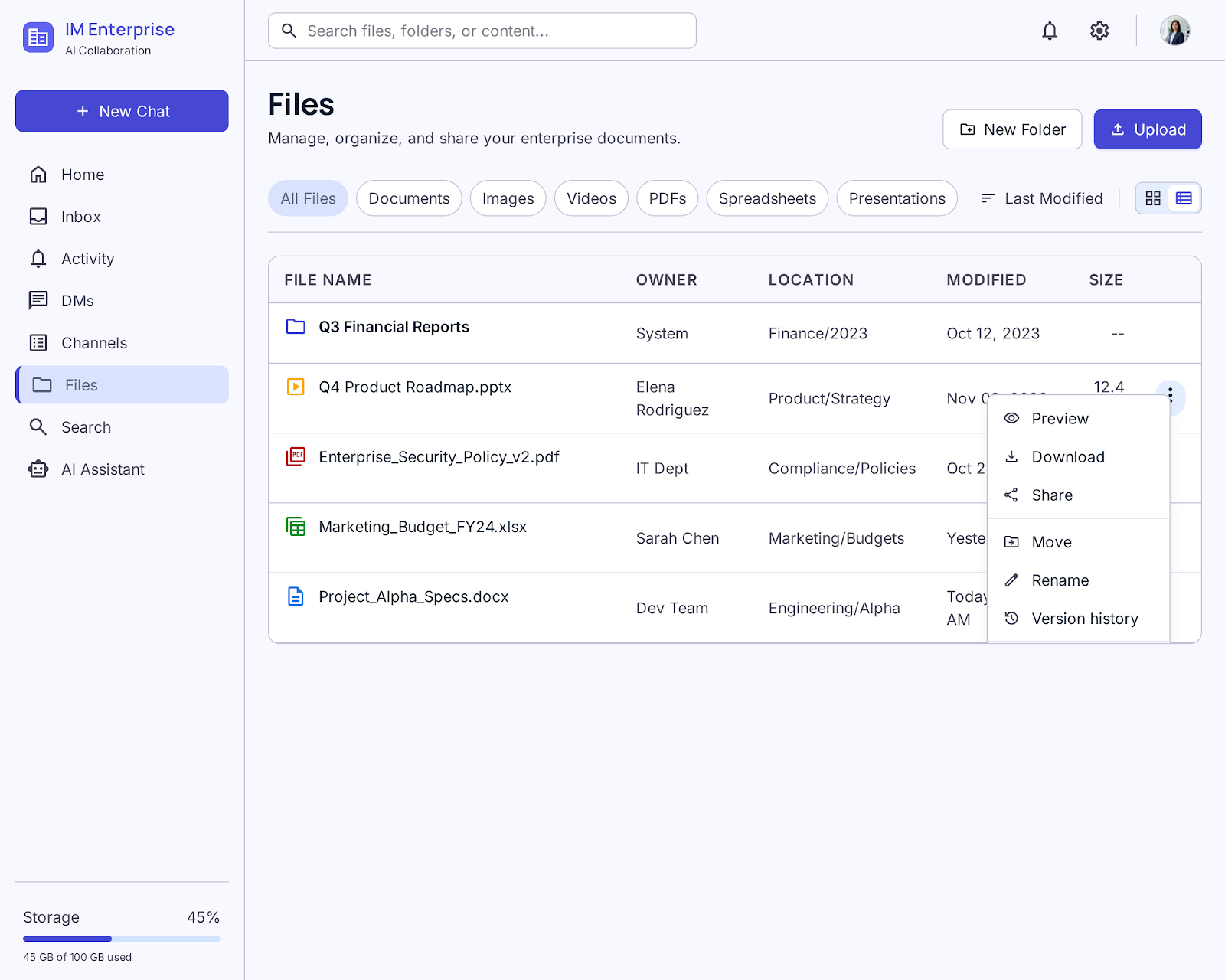
Upload, preview, and co-edit documents with OnlyOffice integration. Every object lives in your S3-compatible storage — MinIO by default — with ClamAV scanning and signed URLs.
Permission-aware search across messages and files. Choose PostgreSQL full-text or Elasticsearch for larger deployments — indexing respects membership before results surface.
Optional intelligence layer: RAG-powered Ask AI, channel summaries, task and decision detection, document suggestions — all filtered through the same RBAC that guards your data.
Customer admins manage users, roles, channels, branding, SSO/MFA, and the capability matrix. Platform operators run a separate console for multi-brand deployments.
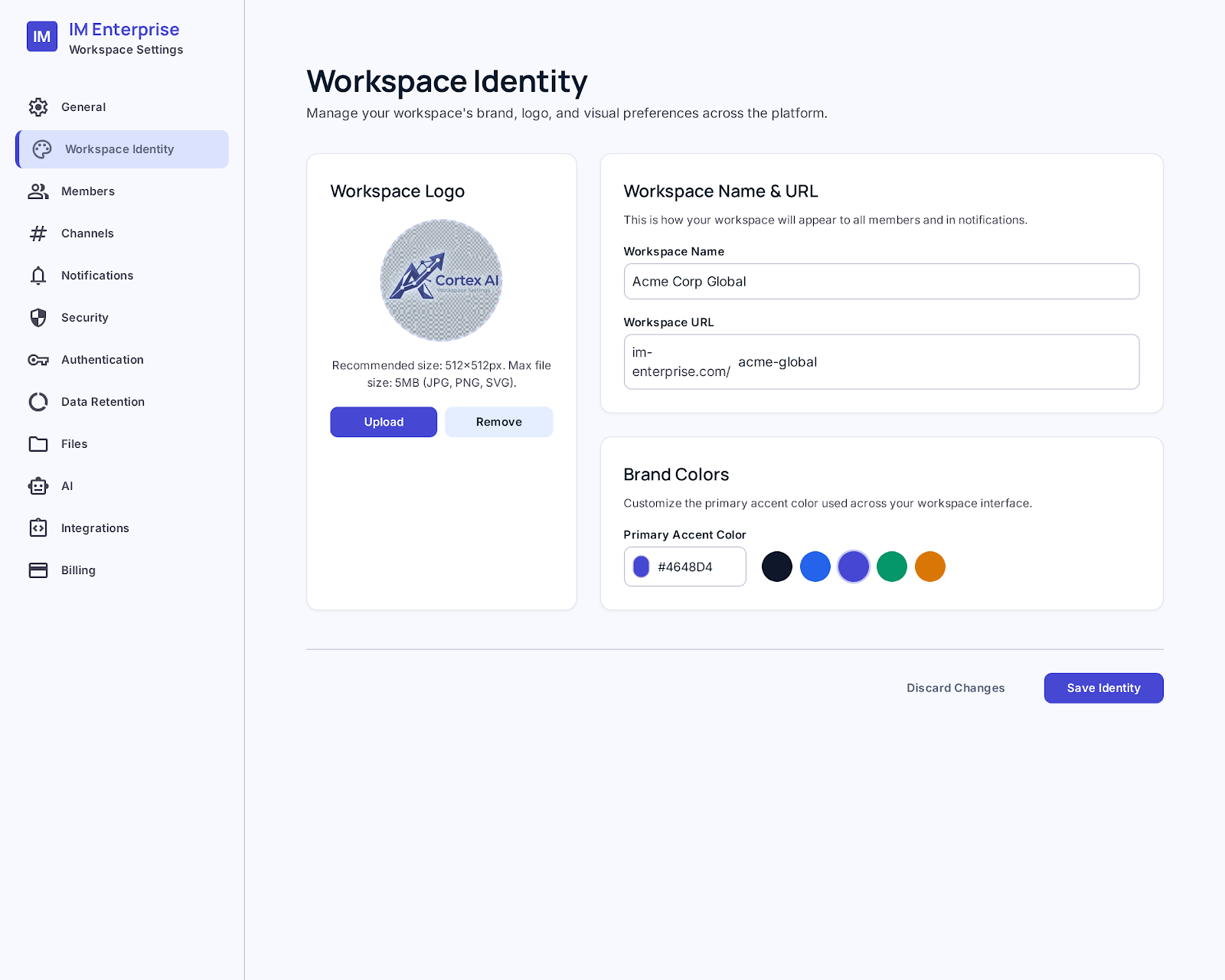
Organizations, workspaces, and brands — isolated at the database with Row-Level Security policies.
Postgres, Redis, MinIO, ClamAV, OnlyOffice, AI worker — one Compose stack, core or full profile.
Custom domains, logos, color tokens, and mobile app stamping for MSPs and enterprise IT.
Your network. Your rules.
IM Enterprise ships as a production-grade monorepo — Next.js web app, WebSocket gateway, background AI worker, and shared packages for auth, storage, and intelligence. No opaque micro-SaaS dependencies.
View on GitHubSecurity in depth
Every tenant-owned row carries organizationId. PostgreSQL policies deny access when tenant context is unset — isolation is structural, not conventional.
All permission checks flow through a single auth package. Routes do not implement ad-hoc role logic — reducing audit surface and privilege escalation risk.
RAG retrieval applies membership filters before content reaches any LLM. If a user cannot read a channel, the model cannot either.
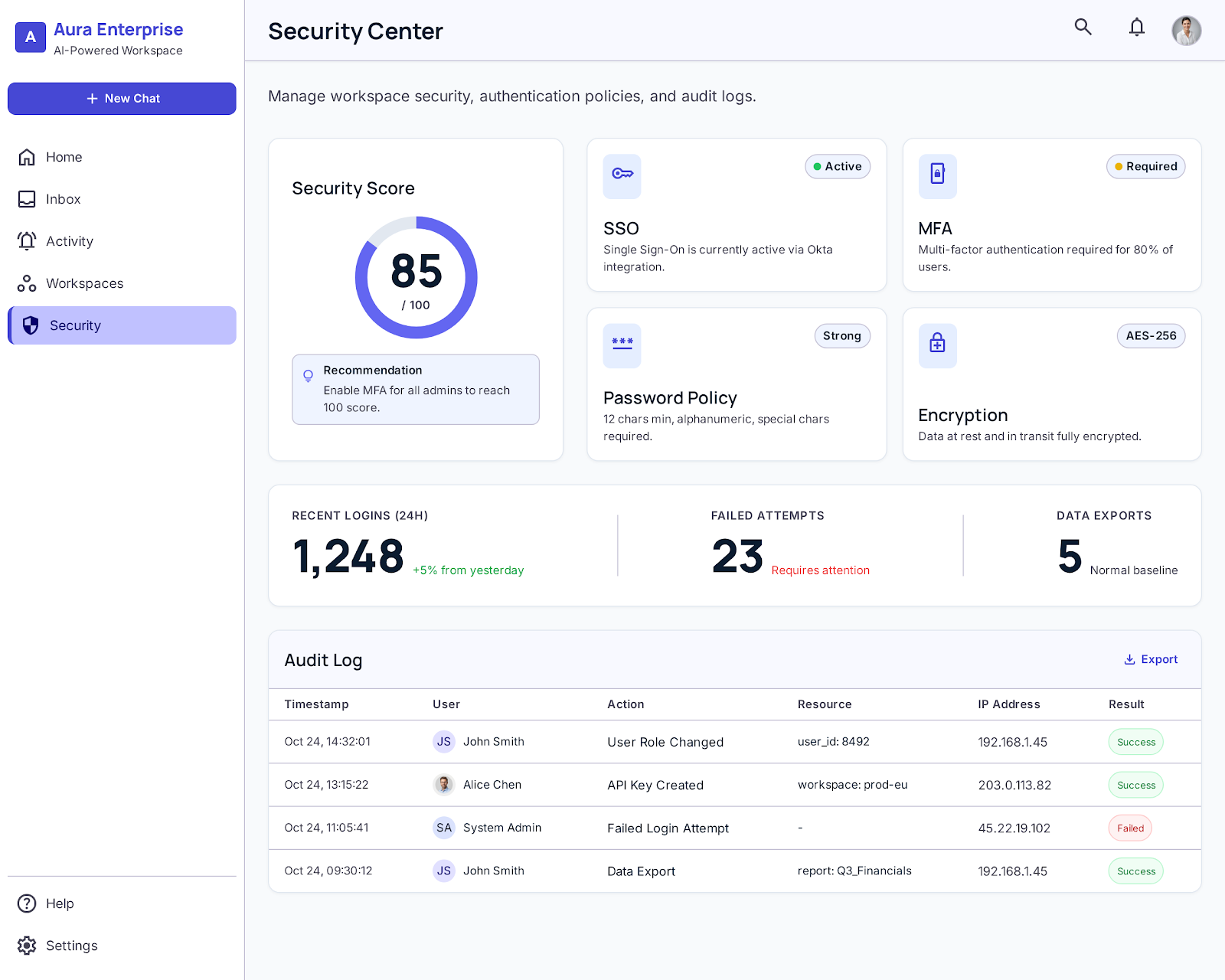
Security-sensitive actions append to an append-only log. Export for compliance reviews without vendor mediation.
Multi-factor authentication and SSO/SCIM scaffolding for enterprise identity integration — required by default in regulated vertical presets.
Objects are never served from public buckets. URLs are short-lived, scoped, and revocable.
Industry-ready presets
Apply a vertical preset at onboarding — then override any toggle. Government, finance, energy, and technology each ship with a tuned capability matrix.
Code ownership
IM Enterprise is not a locked SaaS box. You get deployment, customization, and full control — including ownership of the changes your team makes to the core platform.
If you have internal engineering teams, extend IM Enterprise directly — add modules, integrations, and workflows on your schedule. No vendor gatekeeping, no feature request queue that never ships.
Need capabilities beyond the standard platform? Tell us what you need and Scalovate will build it for you — or assign your own developers if you prefer to keep everything in-house.
IM Enterprise includes deployment and customization support — and the enhancements you make to the core become your intellectual property. You are not renting features; you are investing in an asset.
Why IM Enterprise
Messages, files, embeddings, and audit logs remain on infrastructure you provision and monitor.
No per-seat escalation as headcount grows. Scale compute horizontally — not recurring license tiers.
Run models locally. Toggle every AI surface per org. Block external APIs entirely when policy demands it.
MSPs and integrators deploy under their brand — custom domains, mobile apps, and operator console included.
TypeScript monorepo with documented threat model, migration path, and Docker deployment — not a black-box appliance.
Internal teams can add features directly — or Scalovate builds what you need. Customizations to the core are yours to keep as IP.
Talk to Scalovate about licensing, deployment architecture, and vertical configuration for your organization.